I’m moving from the idea that, not only do we not know the final truth about things, but that we can’t know it. I’m not saying that it’s all pointless, or that we can’t improve our knowledge, but that we will never come face to face with the truth.
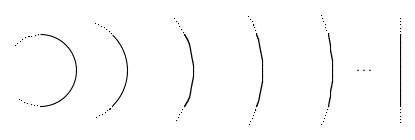
Nicholas of Cusa (1401-1464) was a German cardinal, philosopher, and church administrator. He came up with a mathematical analogy for this phenomenon. If truth is a perfect circle, our knowledge is a polygon. As the number of sides to the polygon increases, it more closely approximates the circle. But no polygon – no matter how many sides – actually coincides with the circle. Which led Nicholas to say, “Hence reason, which is not the truth, can never grasp the truth so exactly that it could not be grasped infinitely more accurately.”


 And he was able to reason years before Copernicus that, because the universe had no boundaries, it had no fixed center, which ruled out the theory that the earth occupied that center. Instead, the earth was in motion. And since the earth was in motion, all our astronomical measurements were off at least slightly because they assumed a fixed observation point.)
 Nicholas also recognized – and our legal system does the same – that something that is not the whole truth is not truth at all but is in some way false, just like a witness leaving out a critical detail that changes guilt into innocence. Because we do not comprehend the totality of the universe, we, in a sense, comprehend nothing.
Of course, these ideas are not new. Way back when, Socrates said, “I know nothing except the fact of my ignorance.” Friedrich Nietzsche made Nicholas’ conclusion explicit: “Parmenides said, ‘one cannot think of what is not’; we are at the other extreme, and say what can be thought of must certainly be a fiction.” Wallace Stevens adds, “The final belief is to believe in a fiction, which you know to be a fiction, there being nothing else. The exquisite truth is to know that it is a fiction and that you believe in it willingly.” This, for Stevens, however, is not an unhappy state: “It is the unknown that excites the ardor of scholars, who, in the known alone, would shrivel up with boredom.”
* * *
Rationalists, wearing square hats,
Think, in square rooms,
Looking at the floor,
Looking at the ceiling.
They confine themselves
To right-angled triangles.
If they tried rhomboids,
Cones, waving lines, ellipses --
As, for example, the ellipse of the half-moon --
Rationalists would wear sombreros.
Wallace Stevens
Think, in square rooms,
Looking at the floor,
Looking at the ceiling.
They confine themselves
To right-angled triangles.
If they tried rhomboids,
Cones, waving lines, ellipses --
As, for example, the ellipse of the half-moon --
Rationalists would wear sombreros.
Wallace Stevens