Friday, July 27, 2012

Thursday, July 26, 2012
Letters of Note
If you haven't bookmarked "Letters of Note" yet, get on it. Here's a letter Ted Turner received from his father after he learned that Ted wanted to major in Classics at Brown. I've read a lot of boring, inarticulate rants against ivory tower elitism, so it was fun to read an intelligent one. Ted Turner's dad sounds like a real Hemingway type:
There is no question but this type of useless information will distinguish you, set you apart from the doers of the world. If I leave you enough money, you can retire to an ivory tower, and contemplate for the rest of your days the influence that the hieroglyphics of prehistoric man had upon the writings of William Faulkner. Incidentally, he was a contemporary of mine in Mississippi. We speak the same language—whores, sluts, strong words, and strong deeds.
Wednesday, July 25, 2012
Least Credible Books of History Contest
Via New York Times:
After a week of voting by readers, David Barton’s “The Jefferson Lies” won with some 650 votes, narrowly edging the left-wing historian Howard Zinn’s“People’s History of the United States,” which received 641 votes.Some quotes about each of the top 5 books.
Penn State and the Milgram experiment
Perhaps the officials at Penn State should have paused occasionally in their highly structured, detail oriented lives and spent some quality time thinking about big picture issues such as the meaning of the Milgram experiment. And it wouldn't have mattered what interpretation they embraced.
From listening to the stories of the people involved, some appear to follow a more traditional interpretation: an organizational structure run by powerful individuals discouraged people from following their own moral compass. As one janitor said when asked by another whether they should report the problem, "No, they'll get rid of all of us."
Also, the ideological reverence of football, singled out in the Freeh report, discouraged some from following their own moral compass. Powerful figures may have struggled with the moral dilemma of addressing the child molesting problem versus their ideological belief in the good name and importance of Penn State and it's athletic department.
From the Freeh report:
We know, from the Milgram experiments, that this would have happened in most any university, not just Penn State. Sixty-five percent of them would have gone all the way.
Would it have made a difference if these powerful officials knew, understood, and thought about the meaning of the Milgram experiments? And should every organization, from universities to churches to governments, think about the Milgram experiments before writing their bylaws?
From listening to the stories of the people involved, some appear to follow a more traditional interpretation: an organizational structure run by powerful individuals discouraged people from following their own moral compass. As one janitor said when asked by another whether they should report the problem, "No, they'll get rid of all of us."
Also, the ideological reverence of football, singled out in the Freeh report, discouraged some from following their own moral compass. Powerful figures may have struggled with the moral dilemma of addressing the child molesting problem versus their ideological belief in the good name and importance of Penn State and it's athletic department.
From the Freeh report:
"It is more reasonable to conclude that, in order to avoid the consequences of bad publicity, the most powerful leaders at Penn State University – Messrs. Spanier, Schultz, Paterno and Curley – repeatedly concealed critical facts relating to Sandusky's child abuse from the authorities, the Board of Trustees, Penn State community, and the public at large. Although concern to treat the child abuser humanely was expressly stated, no such sentiments were ever expressed by them for Sandusky's victims."
We know, from the Milgram experiments, that this would have happened in most any university, not just Penn State. Sixty-five percent of them would have gone all the way.
Would it have made a difference if these powerful officials knew, understood, and thought about the meaning of the Milgram experiments? And should every organization, from universities to churches to governments, think about the Milgram experiments before writing their bylaws?
Thursday, July 19, 2012
200 Years Later
Sometimes fact is stranger than fiction; sometimes it’s
equally strange. According to Leonard Wibberley, author of The Mouse that Roared, in 1955, the Duchy of Grand
Fenwick had armed forces comprised of 700 bowmen and 20 men-at-arms. Its most advanced weapon was the
longbow. Nevertheless, this small
country declared war on the then nuclear-armed United States, and subsequently
launched an invasion against the US.
If we turn back the pages of history 200 years, United
States in 1812 was a fledgling country with fewer than 7000 troops and a navy
of only 16 warships. It nevertheless decided
to declare war on Great Britain, arguably the most powerful nation in the world
at the time. Britain had an army of over
a quarter of a million men, and a navy of 600 warships.
What boosted American confidence was Canada, the low-hanging
fruit. At the time, the population of
Canada was a mere 300,000; compared with America’s 8 million. Thomas Jefferson had declared, “The acquisition
of Canada, this year … will be a mere matter of marching.” Jefferson’s words returned to haunt him after
the first two attempts at invasion ended by the complete surrender of American forces.
The American navy fared better. Although we had nowhere near the naval power
to challenge the British strategically at sea, America won moral victories in
single ship duals with British frigates.
We all learned of one such victory – the Constitution versus the Guerriere
– in grade school. It was
disheartening enough to the British that George Canning, Britain’s foreign
secretary, told parliament that these American victories threatened nothing
less than “the sacred spell of the invincibility” of the royal navy.
The real turning points in the war, however, were the
American naval victories of Commodore Oliver Perry in the battle of Lake Erie
and Commodore Thomas MacDonough (any
relation?) in the battle of Lake Champlain.
These thwarted British invasions of the US from the north and, when the
Duke of Wellington advised his government that no victory in America could be
achieved without naval superiority in the Great Lakes, a peace treaty was only
a matter of time.
The War of 1812 was not James Madison’s finest hour. His refusal to make full use of the navy and
the bungled attempts at the invasion of Canada showed him to be something other
than a man of action.
Madison, however, by the end of the war, distinguished
himself in two ways. First, he showed
that he could learn and at some point began to recognize the importance of a
strong American navy. But, more
importantly, throughout the entire conflict, he stuck to his republican
principles. Unlike the Federalists who,
during the quasi war with France in 1789 passed the alien and sedition act and
otherwise tried to suppress the opposition, Madison, as one admirer put it,
withstood widespread opposition to the war, “without one trial for treason or
even one prosecution for libel.”
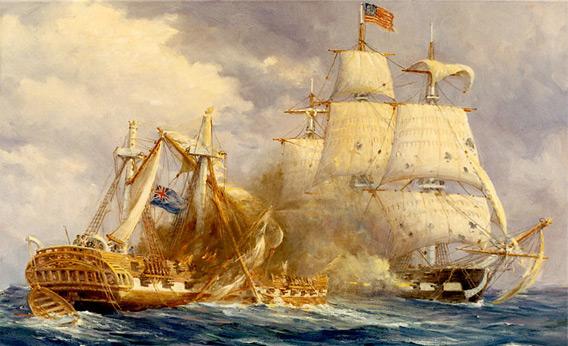
Anton Otto painting depicting the victory of the USS Constitution over HMS Guerriere
Arab Spring continues as Saudi Arabia sends first female athletes to the Olympics
Let's keep the humor going. Saudi Arabian athletes Wodjan Ali Seraj Abdulrahim Shahrkhani and Sarah Attar will be the first ever women in the history of this ancient country (OK, 1932 isn't all that ancient.) to compete in the summer Olympics. Wodjan will compete in judo and Sarah in the 800 meter run.
Of course neither of them is from Saudi Arabia, and the nation does not have Olympic qualifying trials for women. Sarah Attar was born and raised in California and is a sophomore at Pepperdine. I'm not sure where Wodjan Ali Seraj Abdulrahim Shahrkhani is from, but I did read she was not raised in Saudi Arabia. So, although you will see plenty of headlines proclaiming that Saudi Arabia is 'sending' two female athletes, that's not quite true. It's more like two women with Saudi citizenship will compete under the Saudi flag. And that required a lot of work (and rule breaking) on the part of the Olympic Committee.
Wodjan Ali Seraj Abdulrahim Shahrkhani remains a mystery guest to me. Sarah Attar ran track and cross country in high school but is not on the Pepperdine team. She is working out, however. Her fastest time for the 800 is 2:30. The qualifying time for A and B countries respectively is 1:59 and 2:00.
Of course neither of them is from Saudi Arabia, and the nation does not have Olympic qualifying trials for women. Sarah Attar was born and raised in California and is a sophomore at Pepperdine. I'm not sure where Wodjan Ali Seraj Abdulrahim Shahrkhani is from, but I did read she was not raised in Saudi Arabia. So, although you will see plenty of headlines proclaiming that Saudi Arabia is 'sending' two female athletes, that's not quite true. It's more like two women with Saudi citizenship will compete under the Saudi flag. And that required a lot of work (and rule breaking) on the part of the Olympic Committee.
Wodjan Ali Seraj Abdulrahim Shahrkhani remains a mystery guest to me. Sarah Attar ran track and cross country in high school but is not on the Pepperdine team. She is working out, however. Her fastest time for the 800 is 2:30. The qualifying time for A and B countries respectively is 1:59 and 2:00.
All the women who participate in the Olympics must wear “suitable clothing that complies with Sharia [Islamic Law], be accompanied by a male guardian at all times and may not mix with men during the Games." said Saudi Olympic committee chairman and sports minister Prince Nawaf bin Faisal.Sarah obviously believes her Olympic moment will be worth it.
Thursday, July 12, 2012
Seven Minutes of Terror
This is either the slickest piece of self-promotion in the history of science or a preview of the most technically difficult achievement by humankind to date. Maybe both.
Wednesday, July 11, 2012
Freakonomics Motto Contest
I may have mentioned this before, but some four years ago, the Freakonomics blog hosted a contest for a motto for the United States. Recently, I was reminded of this contest. It was inspired by England’s search for a national motto (suggestions ranged from “No Motto Please, We’re British” to “One Mighty Empire, Slightly Used”). The only rule for the Freakonomics contest was that the motto had to be in 6 words. The winning entry (by readers’ vote) was “Our Worst Critics Prefer to Stay” followed by “Caution! Experiment in Progress Since 1776.” There were over a thousand entries, and I made a point of noting some of the more clever ones, as follows:
Just like Canada, with Better Bacon.
Everyone hates us; immigration way up.
No, we still don’t like soccer.
Luckily, our parents left your country.
Now with 20 percent more Mexicans.
Quiet, or we’ll liberate you too!
The Folks Who Brought You Democracy
We’ve got the Coen Brothers. You?
Didn’t We Save Your Ass Once?
The U.S.A (Warning: may contain nuts)
We’re not compensating for anything. Honest.
The most gentle empire so far.
OK, everybody into the gene pool!
Hello? We are the armed Canadians.
With Great Power….Something. We forget.
Coming to your military theater soon.
Lots of schools. Not many mimes.
Not just a Spanish explorer’s surname.
Nation of immigrants, but we forgot.
Liberty! Equality! Fraternity! Partying! Beer! Uh-oh!
Not arrogant. Just better than you.
America: Easier to spell than Kyrgyzstan.
Leftists Whine; Rightists Parry; Bedlam Accomplished
Just like Canada, with Better Bacon.
Everyone hates us; immigration way up.
No, we still don’t like soccer.
Luckily, our parents left your country.
Now with 20 percent more Mexicans.
Quiet, or we’ll liberate you too!
The Folks Who Brought You Democracy
We’ve got the Coen Brothers. You?
Didn’t We Save Your Ass Once?
The U.S.A (Warning: may contain nuts)
We’re not compensating for anything. Honest.
The most gentle empire so far.
OK, everybody into the gene pool!
Hello? We are the armed Canadians.
With Great Power….Something. We forget.
Coming to your military theater soon.
Lots of schools. Not many mimes.
Not just a Spanish explorer’s surname.
Nation of immigrants, but we forgot.
Liberty! Equality! Fraternity! Partying! Beer! Uh-oh!
Not arrogant. Just better than you.
America: Easier to spell than Kyrgyzstan.
Leftists Whine; Rightists Parry; Bedlam Accomplished
Saturday, July 7, 2012
Quote of the Day
"There are two kinds of people in the world to me: those who are humble, and those who are about to be."
—Clint Hurdle, Pirate Manager
—Clint Hurdle, Pirate Manager
Thursday, July 5, 2012
Scientific discovery means different things to different people
To most of the world, at least those who like to know why we aren't all traveling around at the speed of light with no mass, the discovery of the Higgs boson confirming that a Higgs field exists, is important in our progress in understanding how the universe works. To others it is a strange message in typography.
Here is a video explanation of the Higgs field. It may be easier to understand than the typography argument.
I guess I should add that scientists are certain that they found a particle. Now, with more experimentation, they will determine how similar the behavior of it is to the predicted Higgs particle.
Here is a video explanation of the Higgs field. It may be easier to understand than the typography argument.
I guess I should add that scientists are certain that they found a particle. Now, with more experimentation, they will determine how similar the behavior of it is to the predicted Higgs particle.
Monday, July 2, 2012
Poor Salesmanship
Below are some of the results from the recent Atlantic/Aspen Institute American Values Survey. Both polls show that a majority of people believe that the government should be involved in insuring universal health care. So, why is Obama's plan so unpopular? It's hard to avoid the conclusion that Obama just hasn't done a good job communicating what's in the Affordable Care Act and how it will affect citizens. People don't oppose because they've studied it and don't like it. They oppose it because they don't understand it.


Saturday, June 30, 2012
You Only Kiss Me When You're Drunk
Like, who hasn't been in this situation before?
Also, Bob says that the piano is the greatest of all the instruments. I think this performance clinches it.
Also, Bob says that the piano is the greatest of all the instruments. I think this performance clinches it.
Friday, June 29, 2012
The Stuff a Judge Has to Know These Days
UNITED STATES DISTRICT COURT
MIDDLE DISTRICT OF FLORIDA
TAMPA DIVISION
UNITED STATES OF AMERICA
v. CASE NO.: 8:11-cr-269-T-23AEP
CRISTIE FAY BOTTORFF
JERRY ALAN BOTTORFF
LUIS ANGEL LOPEZ
ORDER
Jerry Alan Bottorff stands accused of murder-for-hire, conspiracy to commit murder-
for-hire, and a firearm offense. For four months the parties have known with particularity
when the trial begins -- July 9, 2012; the parties requested the special setting. Nonetheless,
Bottorff's counsel asks (Doc. 127) to suspend the trial on Friday, July 20th:
Undersigned counsel, a perennial contestant in the Ernest Hemingway Look-alike Contest, is scheduled to appear as a semi-finalist at Sloppy Joe's Bar in Key West, Florida at 6:30 P.M. on Friday, July 20, 2012.Between a murder-for-hire trial and an annual look-alike contest, surely Hemingway, a
In order to be able to be in Key West at the appointed hour, undersigned counsel has planned to depart St. Petersburg after the trial recesses on Thursday, July 19, 2012, and drive toward Key West[,] arriving on July 20, 2012.
Undersigned counsel has secured a block of six rooms to accommodate family, friends, and fans and has had to pay non-refundable deposits.
perfervid admirer of grace under pressure, would choose the trial. At his most robust,
Hemingway exemplified the intrepid defense lawyer:
He works like hell, and through it. . . . He has the most profound bravery. . . . He has had pain[] and the kind of poverty that you don't believe[;] he has had about eight times the normal allotment of responsibilities. And he has never once compromised. He has never turned off on an easier path than the one he staked himself. It takes courage.
Dorothy Parker, The Artist's Reward, THE NEW YORKER, Nov. 30, 1929, at 28-30 (describing
Hemingway). Perhaps a lawyer who evokes Hemingway can resist relaxing frolic in favor of
solemn duty.
Or, at least, "Isn't it pretty to think so?"”
Best of luck to counsel in next year's contest. The motion (Doc. 127) is DENIED.
ORDERED in Tampa, Florida, on June 22, 2012.
STEVEN D. MERRYDAY
UNITED STATES DISTRICT JUDGE
Thursday, June 28, 2012
Supreme Court Upholds the Individual Mandate
Court opinion: National Federation of Independent Business v. Sebelius. Warning: the decsion itself is 59 pages. And with dissents and concurrences, much longer.
Wednesday, June 27, 2012
Music Break
In March of this year, Joan Osborne came out with an all blues album, Bring it on Home. It's definitely worth checking out. She's come a long way from "(What if God Was) One of Us." Anyway, the blues album took me back to her concert with the Funk Brothers and perhaps the greatest cover since Talking Heads' "Take Me to the River." I never tire of listening to this.
Saturday, June 23, 2012
Patently Legal
Normally I do not make this type of post, but I will in this case because:
- It relates to smart people thinking stupidly (in this case, Steve Jobs).
- It relates to the law.
- It may be of interest to the only person I know for certain, other than Professor Alex Haslam, who reads this blog.
Friday, June 22, 2012
Never trust your intuition
Perhaps some saw the Kottke reference to the map of Major League Baseball players' hometowns. The same post also referenced a map of Nation Hockey League players' hometowns. Continuing in the "never trust your intuition" vein: Who has more players in the NHL Boston or Pittsburgh?
Here is the answer:

Here is the answer:

Germany vs. Greece
This afternoon, Germany will face Greece in the Euro quarterfinal match. Tensions are already running high betwen these two counties as Germany continues to impose austerity measures and the European community hangs in the balance.
The two teams, however, met in an even more momentous game back in 1972.
The German lineup was loaded: Kant, Hegel, Nietzsche, Franz Beckenbauer. But the Greeks were able to counter with the likes of Plato, Socrates and Archimedes. Germany tried a daring substitution, which failed to break any paradigms, but it was Greece that had the Eureka moment.
The two teams, however, met in an even more momentous game back in 1972.
The German lineup was loaded: Kant, Hegel, Nietzsche, Franz Beckenbauer. But the Greeks were able to counter with the likes of Plato, Socrates and Archimedes. Germany tried a daring substitution, which failed to break any paradigms, but it was Greece that had the Eureka moment.
Tuesday, June 19, 2012
Why Smart People Are Stupid
I still lie awake at night trying to understand why intelligent people can't agree on more things. In theory, all intelligent people should be equally able to recognize fallacious logic and unsupported conclusions. So, while they may disagree on the really hard questions, they should be able to have a meeting of the minds about the clearly wrongheaded. And yet, I have this fellow in my office -- he was, like, .0001 away from being class valedictorian at his posh high school, attended and graduated from Haverford College and Georgetown Law School, and clerked for a federal judge -- trying to convince me that global warming is a complete hoax.
I made sort of a feeble stab at this before in our blog. See Why Your Political Opponents Are Crazy. The post linked to an article by Notre Dame philosophy professor Gary Gutting that said that everyone starts with their own assumptions -- first premises -- about the world which are not particularly rational. Gutting calls them pictures. As he says, "Hardly anyone holds either of these rival pictures as the result of a compelling logical argument. Pictures come to have a hold on us from a complex mixture of family influences, schooling, personal experiences, discussions with friends, reading newspapers and blogs, and more." The article goes on to argue that, while there will never be agreement about the big pictures, most people concede that there will always be exceptions. It is in the details of those exceptions where we might reach agreement despite our political differences.
Now, I see an article in the New Yorker which presents a more dismal explanation for our lack of agreement: even the brightest of us do not think logically. See Why Smart People Are Stupid. This piece by journalist Jonah Lehrer examines the work of Daniel Kahneman, Nobel Laureate and professor of psychology at Princeton. According to Kahneman's research, we take mental shortcuts which lead to foolish conclusions. We have built in biases that, even when we are fully aware of them, we cannot overcome.
As the article points out, "[p]erhaps our most dangerous bias is that we naturally assume that everyone else is more susceptible to thinking errors, a tendency known as the 'bias blind spot.'" We can see the mental errors of others but can't spot the same errors in ourselves. In other words, we beholdest the mote that is in our brother's eye, but considerest not the beam that is in our own eye.
And here's the kicker, increased intelligence only increases the size of our bias blind spot.
Anyway, I've summarized just a few points. Overall, the piece is an eye-opener, although it may lead you to conclude that trying to reach rational unbiased answers to any question is an utterly hopeless undertaking.
I made sort of a feeble stab at this before in our blog. See Why Your Political Opponents Are Crazy. The post linked to an article by Notre Dame philosophy professor Gary Gutting that said that everyone starts with their own assumptions -- first premises -- about the world which are not particularly rational. Gutting calls them pictures. As he says, "Hardly anyone holds either of these rival pictures as the result of a compelling logical argument. Pictures come to have a hold on us from a complex mixture of family influences, schooling, personal experiences, discussions with friends, reading newspapers and blogs, and more." The article goes on to argue that, while there will never be agreement about the big pictures, most people concede that there will always be exceptions. It is in the details of those exceptions where we might reach agreement despite our political differences.
Now, I see an article in the New Yorker which presents a more dismal explanation for our lack of agreement: even the brightest of us do not think logically. See Why Smart People Are Stupid. This piece by journalist Jonah Lehrer examines the work of Daniel Kahneman, Nobel Laureate and professor of psychology at Princeton. According to Kahneman's research, we take mental shortcuts which lead to foolish conclusions. We have built in biases that, even when we are fully aware of them, we cannot overcome.
As the article points out, "[p]erhaps our most dangerous bias is that we naturally assume that everyone else is more susceptible to thinking errors, a tendency known as the 'bias blind spot.'" We can see the mental errors of others but can't spot the same errors in ourselves. In other words, we beholdest the mote that is in our brother's eye, but considerest not the beam that is in our own eye.
And here's the kicker, increased intelligence only increases the size of our bias blind spot.
Anyway, I've summarized just a few points. Overall, the piece is an eye-opener, although it may lead you to conclude that trying to reach rational unbiased answers to any question is an utterly hopeless undertaking.
Subscribe to:
Posts (Atom)