Friday, April 4, 2014

Jesus and Dualistic Thinking


I have recently come across several articles that make the argument that the reason for the decline of religion in the last two decades or so is not due to its rightward drift but because it has grown slack and essentially spineless.  It no longer stands firm in defense of core beliefs but has allowed tenets of faith to become matters left to the individual.  Recall the old joke about the ten commandments becoming the ten suggestions.  This departure from adherence to straightforward religious doctrine has made it almost indistinguishable from the secular world.  At that point, so the argument goes, why bother with religion at all?

The NY Times’ columnist Ross Douthat is one of those making this charge.  With his book, Bad Religion, he argues that Christianity’s decline follows from its accommodation of modernism and its adoption of the view that beliefs and commands are optional:  “A choose-your-own-Jesus mentality encourages spiritual seekers to screen out discomfiting parts of the New Testament and focus only on whichever Christ they find most congenial.”  It is this trend that that drives the conservative Catholics’ concern about Pope Francis:

And they worry as well that we have seen something like his strategy attempted before, when the church’s 1970s-era emphasis on social justice, liturgical improvisation and casual-cool style had disappointing results: not a rich engagement with modern culture but a surrender to that culture’s “Me Decade” manifestations — producing tacky liturgy, ugly churches, Jonathan Livingston Seagull theology and ultimately empty pews.

And so, the implication is that, for religion to thrive, it must adhere to established rules and doctrines and remain steadfast to the conviction that, besides the one truth, there is no other truth.

On the other hand, as more fully set forth in a prior post, Republicans and Religion, I have also read about studies which suggest that religion’s identification with conservative Republican politics is the actual cause of its decline.

Now, I don’t really know who is right on this issue.  But, that isn’t my concern in this post.  This debate actually raises for me a completely different and slightly more interesting question:  must religion, or at least Christianity, always and everywhere fit into this dichotomy, as everyone seems to believe: that religion is either lukewarm and wishy-washy or strident and bent on thought control?  Is it possible to have a tough and demanding religion without its being moralistic and autocratic?  Must we choose between Jonathan Livingston Seagull and the inquisition?


Once I applied myself to this quandary, it didn’t take long for me to realize that this tough anti-status quo yet non-doctrinaire approach precisely describes the preaching of Jesus.  Time and time again he makes difficult, nigh on impossible demands on people – but he never requires adherence to particular rules, nor does he spell out a creed or ultimate truth that people must accept.  Instead, he leaves the responsibility of figuring out things out to the individual.

First, even though Jesus says at one point "Do not think that I have come to abolish the Law or the Prophets" (Matthew 5:17), its clear that he didn’t much like rules.   He takes direct aim at the scribes and Pharisees by claiming, “their teachings are merely human rules.” (Matthew 15:9)  He then gives the Pharisees a hard time when they criticize his disciples for picking grain in violation of the Sabbath rules, explaining to them that, "The Sabbath was made for man, not man for the Sabbath.” More than once he heals on the Sabbath in violation of Jewish law. And, when he heals a man with a withered hand in a synagogue on the Sabbath, the Pharisees got so offended that they immediately “went out and plotted how they might kill Jesus.”  (Matthew 12:14)  And, he didn’t really care for the Jewish dietary laws, either. "Don't you see that nothing that enters a man from the outside can make him 'unclean'?” (Mark 7:18)  Certainly, the notion of the law as a test for fidelity was completely foreign to Jesus.

While Jesus rejected formal rules as a basis for conduct, he did not adopt a follow-your-own-dream attitude.  Instead, he replaced legalistic requirements with far more demanding and broader commands, which finally could never be completely fulfilled.  Jesus makes it clear that the greatest commandment, loving God and neighbor, is without limit.  He explains, “You have heard that it was said to the people long ago, ‘You shall not murder, and anyone who murders will be subject to judgment.’  But I tell you that anyone who is angry with a brother or sister will be subject to judgment.”  (Matthew 5:22)  Nor is this love restricted to one’s friends.  You must also love your enemies (Matthew 5:43-44).  And, it’s no longer an eye for an eye but one must turn the other cheek.  So, if anyone sues you for your shirt, hand over your coat to him as well.  (Mathew 5:38-40)  Ultimately, Jesus insists that we be “perfect, even as your Father that is in heaven is perfect.”
 
The flip side of loving your neighbor is not being so concerned about yourself:  "Therefore, I tell you, do not worry about your life, what you will eat; or about your body, what you will wear.”  (Luke 12:22)  Indeed, "sell everything you have and give it to the poor." (Mark 10:17-22).   “Do not store up for yourselves treasures on earth" (Matthew 6:19) for "you cannot serve both God and Money.”  (Matthew 6:24). "None of you can become my disciple if you do not give up all your possessions" (Luke 14:33).

Yet, even at his most strident, Jesus is not moralistic.   Recall this rather difficult passage:  “And if thy hand offend thee, cut it off: it is better for thee to enter into life maimed, than having two hands to go into hell.” (Mark 9:43) And then he says the same thing one’s foot and one’s eye.  (Mark 9:45, 47)  He never even hints, however, at what sort of behavior might prompt this sort of drastic action.  He leaves that determination to us.  But the import is clear:  what you do with yourself is what counts.

And, by the way, it all must be done yesterday.  For Jesus, the decision for others is an urgent one.  Jesus says to one man who says he’ll follow Jesus but first needs to bury his father: “Follow me, and let the dead bury their own dead.” (Matthew 8:22) He also has no time for the person who first wants to say good-bye to his family, and tells him:  “No one who puts a hand to the plow and looks back is fit for service in the kingdom of God.” (Luke 9:62)

It is thus clear that Jesus expected a lot from people and he expected it right way.  You can see why people may have preferred following dietary laws.

While he wants total commitment to one’s neighbor, it’s also clear that how that commitment is carried out is up to us.  And so, he criticizes those who “bind heavy burdens and grievous to be borne, and lay them on men's shoulders.”  (Matthew 23:4)  Indeed, the teachers of the law “shut the door of the kingdom of heaven in people’s faces.”  (Matthew 23:13)  They adhere to the outward observance of the law – “[y]ou give a tenth of your spices – mint, dill and cumin” – but they “have neglected the more important matters of the law – justice, mercy and faithfulness,” straining out a gnat but swallowing a camel.  (Matthew 23:23-24)  Any moralizing is repugnant to Jesus.  "Do not judge, and you will not be judged. Do not condemn, and you will not be condemned. Forgive, and you will be forgiven.” (Luke 6:37; Matthew 7:1).  “And why do you look at the speck in your brother’s eye, but do not consider the plank in your own eye?”  (Matthew 7: 3)

And, lest anyone think that Jesus was pushing some kind of creed or orthodoxy, he, instead, is gleefully inconsistent.  Just above I cited Jesus saying that we must be perfect as the father is perfect.  But then when someone innocently enough addresses Jesus as “good teacher,” he retorts, "Why do you call me good?  No one is good--except God alone.”   (Luke 18:19)

And, at one point he says, “You are the light of the world. … Let your light shine before men in such a way that they may see your good works, and glorify your Father who is in heaven.”  (Matthew 5: 14, 16)  But later in the next chapter he says,  "So when you give to the poor, do not sound a trumpet before you, as the hypocrites do in the synagogues and in the streets, so that they may be honored by men. Truly I say to you, they have their reward in full.  But when you give to the poor, do not let your left hand know what your right hand is doing, so that your giving will be in secret; and your Father who sees what is done in secret will reward you.”  (Matthew 6:2-4)

And again, at another time Jesus says, "He who is not with Me is against Me; and he who does not gather with Me scatters.”  (Matthew 12:30)  But then he also says, "For he who is not against us is for us.”  (Mark 9:40)

Another contradiction:  he states, "Blessed are the peacemakers, for they shall be called sons of God” (Matthew 5:9) And later he says, "Put your sword back in its place, for all who draw the sword will die by the sword.”  (Matthew 26:52)  But then, he tells his followers, “do not suppose that I have come to bring peace to the earth. I did not come to bring peace, but a sword.” (Matthew 10:34)

Perhaps Jesus would agree with Emerson that, "A foolish consistency is the hobgoblin of little minds….” Or, perhaps he understood what Neils Bohr understood:  “the opposite of one profound truth may very well be another profound truth.”  Or, Jesus may simply prove F. Scott Fitzgerald’s point:  “The test of a first-rate intelligence is the ability to hold two opposed ideas in mind at the same time and still retain the ability to function.”

One thing is clear, however:  Jesus demanded a lot from people.  In fact, he demanded their whole lives.  But there were two things he clearly did not demand of them:  that they adhere to a list of ironclad rules; and that they believe in some final truth or doctrine. 
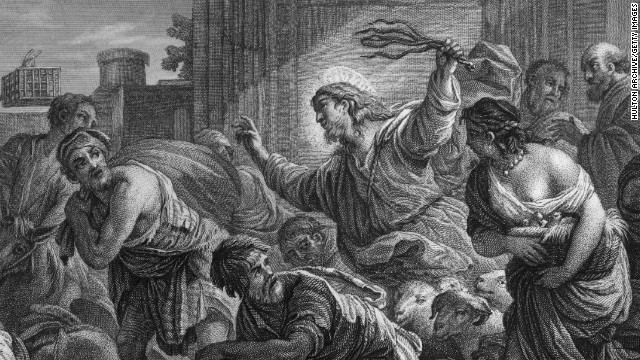
Jesus Cleanses the Temple

Sunday, March 23, 2014

Poetry Sunday - Old Misunderstandings

Old Misunderstandings

I have a fear that in three thousand years,
When science texts become the bible,
But people stay the same
As they came three thousand years ago
when tribal,
That when they read about our quantum deeds
And quirky quarks with spin and charm
They'll be alarmed.
Religiously they'll say it is not so
But libel.
Our scientists, then, will likely be condemned
In that time for preaching lies
When all they tried
To metaphorically record
The grand, uncertain plan or story
Of something they didn't understand
In all its glory.

Monday, March 17, 2014

Quote for St. Patrick's Day


The English language brings out the best in the Irish. They court it like a beautiful woman. They make it bray with donkey laughter. They hurl it at the sky like a paint pot full of rainbows, and then make it chant a dirge for man's fate and man's follies that is as mournful as misty spring rain crying over the fallow earth….  Rarely has a people paid the lavish compliment and taken the subtle revenge of turning its oppressor's speech into sorcery.

T E Kalem

Saturday, March 15, 2014

Quote of the Day

Before John le Carré became a writer, he was an agent for both MI5 and MI6.  While still in the service, he got to know John Bingham, the famed British counter-intellignce agent.  Described as a “genius” agent,  Bigham ran a brilliant operation convincing British Nazi sympathizers that he was a representative of the Gestapo looking for people who could be relied on to help in the event of an invasion.  See The spy who turned Hitler’s British supporters into unwitting double agents.  In any event, Bingham ended up being part of the inspiration for le Carré's George Smiley.

Anyway, with this context I present you with the quote of the day (adding to the discussion, perhaps, about the current revelations of NSA surveillance and drone strikes):

SIR – John Bingham and I were indeed close friends and colleagues. I had, and shall always have, unqualified admiration for his intelligence skills and achievements. He was a most honourable, patriotic and gifted man, and we had wonderful times together.
And surely there can be few better tributes to a friend and colleague than to create – if only from some of his parts – a fictional character, George Smiley, who has given pleasure and food for thought to an admiring public.
But Bingham was of one generation, and I of another. Where Bingham believed that uncritical love of the Secret Services was synonymous with love of country, I came to believe that such love should be examined. And that, without such vigilance, our Secret Services could in certain circumstances become as much of a peril to our democracy as their supposed enemies.
John Bingham may indeed have detested this notion. I equally detest the notion that our spies are uniformly immaculate, omniscient and beyond the vulgar criticism of those who not only pay for their existence, but on occasion are taken to war on the strength of concocted intelligence.
David Cornwell (John le Carré)  
London NW3
Letter to the Daily Telegraph March 5, 2014.

Tuesday, March 11, 2014

Sunday, March 2, 2014

For Poetry Sunday, this is from Renee who heard it from her 12th grade history teacher and has stuck with her since.

When you get all you want and you struggle for pelf,
and the world makes you king for a day,
then go to the mirror and look at yourself
and see what that man has to say.
For it isn't your mother, your father or wife
whose judgment upon you must pass,
but the man, whose verdict counts most in your life
is the one staring back from the glass.
He's the fellow to please,
never mind all the rest.
For he's with you right to the end,
and you've passed your most difficult test
if the man in the glass is your friend.
You may be like Jack Horner and "chisel" a plum,
And think you're a wonderful guy,
But the man in the glass says you're only a bum
If you can't look him straight in the eye.
You can fool the whole world,
down the highway of years,
and take pats on the back as you pass.
But your final reward will be heartache and tears
       if you've cheated the man in the glass.
                       Dale Wimbrow, (c) 1934               
 

Wednesday, February 12, 2014

Stay Connected to (U.S. Drone Killings) Metadata

Finally, you can keep up to date with U.S. signature strikes. After being rejected by Apple five times, data artist Josh Begley finally received approval for his app, now named "Metadata+". You can find it on the AppStore as a free download.

Back in 2012, he submitted an app, originally called "Drones+" that would alert iPhone users when and where a U.S. drone killed some people, hopefully enemies. Apple rejected it, but after 4 more resubmissions he finally got approval. The current app says nothing about drones. Apple wouldn't approve an app reporting that our military actually kills people, but would approve one that had no content. So Begley did just that. "Metadata+" is an empty app which promises "real-time updates on national security".

Metadata+ gets its name from the metadata it gathers to report on the killings. Ironically, metadata is also what the military uses to target the killings. According to a former drone operator, there normally is no personal observation of the targets, just metadata from phones or other devices which "geolocates" the target.

It would be nice if we could compare our killings to our enemies' killings, like the Arabs vs. Israelis or the numerous other 'terrorist' attacks that ageless enemies have used to justify response killings. Currently we have JSOC secret military operations in 75 countries with a fighting force of over 25,000, so that would be a lot of metadata. Incidentally, there has been an incredible expansion of our secret military operations since the Obama administration.

As the documentary "Dirty Wars" reports, we could be on our way to forging some endless wars ourselves with so many attacks in so many places. Nothing creates bitter enemies more than having your sons or daughters as "collateral damage." To date, four U.S. citizens have been killed. Perhaps as testament to the accuracy of our metadata, only one of those were targeted.

Interestingly, Harvard law professor Jack Goldsmith writes he is also concerned about our greatly expanded secret killing brigades—not over the loss of innocent lives, however, but that "One day JSOC operation will make a notorious mistake that will cause the United States awkward embarrassment….". Snowden, it has been speculated, has just such information, but has refrained from releasing it yet.


Metadata+ iPhone App from Josh Begley on Vimeo.

One last thing: here is an articulate Josh Begley giving his graduate thesis. I put a lot of links in this post, but if you wish the core, I'd recommend watching the Josh Begley graduate thesis.

Thursday, February 6, 2014

Pittsburgh: Well, Just Look at You.

I first noticed it in the upward mobility information.  Taken as a whole, America isn't really the land of opportunity.  When it comes to intergenerational mobility, we are close to the bottom of the world's industrial countries.  The UK does worse than we do, but that's because they haven't shed the old class structure that we love so much in Downton Abbey.

But, America is nothing if not diverse.  And, as shown in a recent study by the National Bureau of Economic Research, it turns out that, depending on what part of the country you look at, upward mobility changes significantly.  Thus, Upward mobility is lowest in the Southeast and highest in the Great Plains. The West Coast and Northeast also have high rates of upward mobility.  In any event, to my surprise, out of the top 50 population areas, Pittsburgh was ranked second in the country for absolute upward intergenerational mobility.  


But then more stuff starts popping up.  On February 4, 2014, Politico Magazine published two articles on Pittsburgh.  One item, The Political Makeover of a Rust Belt City, is about the new mayor, Bill Peduto, changing Pittsburgh from an old boys network to a new progressive city.  The second item, The Robots that Saved Pittsburgh, describes how Pittsburgh, after decades of trying to remake itself, now has a new economy, based on a rapidly growing robotic, artificial intelligence, health technology, advanced manufacturing and software industries.  It looks like Pittsburgh is on the cutting edge of everything.

Also from Politico, two photo essays:  From Steel City to Roboburgh, the reinvention of Pittsburgh, and Robots at Work, a visit to CMU's Robotics Institute.

Pittsburgh, yes, just look at you.

Wednesday, February 5, 2014

Dr. Bronowski and the Dangers of Certainty

This meditation, The Dangers of Certainty: A Lesson from Auschwitz, touches on several recurring themes in this blog: (1) the moral dangers of certainty; and (2) science's disavowal of any claim to final knowelge, or as  Jacob Bronowski  says in the old TV show, "The Ascent of Man," science is always at the brink of the known.  It demands that we always consider Oliver Cromwell's plea: “I beseech you, in the bowels of Christ, think it possible you may be mistaken.”

This was published in a New York Times feature called "The Stone," described as "a forum for contemporary philosophers and other thinkers on issues both timely and timeless."  This online feature is usually worth checking out.


Sunday, February 2, 2014

Poetry Sunday - On Poetry That Doth Not Rhyme

On Poetry That Doth Not Rhyme

Deliver me from wasted time
On poetry that doth not rhyme,
And even worse, I prithee ban
Unruly verse that doth not scan.
Presumptuous poets place their faith
In unctuous freedom's flair to saith
Whatever shard doth pierce their head
Without regard to theme or thread.
For florid, free-form composition
Invokes esprit with erudition
To breach beyond harmonious life
Unleashing catastrophic strife
Upon the page, whence tortuous hour
Again I wage uncertain scour,
Unmeasured, of prosodic scraps
In hopes rhapsodic tenor maps
Missed metered lines so broke I rue
The reader-writer pas de deux.
Shake, break, (sigh) concentrate!
'Tis prose so lithe, but such a weight,
Where any line may stop or start
At any length
'cause
   fine
by
art.
Unfettered by constraint, their muse
Reins no restraint to feign, confuse,
And all the sundry parts of speech
Are numbly scattered out of reach
Of any sense I can decipher
Without the patience of a lifer.
The best lack all conviction
Apart from thwacking diction.
The worst have artfully a plan
That only God can understand,
And need eternity's extent
To finally agree what's meant.
I know, there's Yeats and Wallace Stevens,
A few more greats who have their reasons,
But genius hath laid bad example
For would-be bards to gad and trample
Nature, disadvantaged pressed
By thought not oft, nor well express'd.

In rhyme no words are left to roam.
Companionship doth lead them home.
None indiscriminately stroll
Aimlessly without a goal.
All poets should consider God
Obeys our laws, and yet we're awed
By lyric power, boundless grace
From fragrant flower to starlit space.
So if you freely write obscura,
I suggest that you secure a
Rhyming dict. and ruling meter
Stick with discipline, and either
Stop, or practice rod and fettered
Laws, like God, until you're better!