Friday, August 7, 2009
Moneyball Sold to Highest Buyer
Moneyball: The Art of Winning an Unfair Game seems to have been bought by the big spenders, returning baseball to its rightfully place-teams with money win. Though for the Pirates, since they never bothered with Moneyball, its no big loss.

Essential Ware for the Kitchen
My family needs this, heck I need it for my self. Essential kitchenware.
Arguments Against Same Sex Marriage
Why I have resisted writing something like this:
Because there are many issues involved, it would be too lengthy and boring.
Why I have written this:
A great philosopher said, "This ain't heaven." I think she meant that there is nothing in life which is completely good or right (as well as evil or wrong), including this statement.
This is NOT to advocate banning same sex marriage. It is to advocate looking at different sides of an issue. No one wants to fall into the Rush Limbaugh-religious-zealot-syndrome-where-the-other-side-are-all-morons.
I have been influenced by a number of things people said on this blog many months ago. Two notable ones are Myk, when he said "We have bigger fish to fry" and Katty, when she told the story of her gay friend weeping when Proposition 8 passed in California. Myk's point is self explanatory. Katty's point let me see that, while it has been described as a religious and/or a civil rights issue, it is fundamentally a human happiness issue.
These will not be compelling arguments to you, but they will have substance. I don't find them compelling, but perhaps people with other genes, backgrounds and values will. They will be brief and thus you will find a lot of holes in them. I'm sorry, but I will not make this lengthy.
1. At a time when almost everything, from economics to games, is cast in a Dawinian light, we should recognize the fundamentally powerful development of marriage as perhaps the principle reason the race has survived as well as we have.
2. Related to No. 1, perhaps because marriage has been such a powerful force, it obtained religious significance. It has become mystical. Every major religion defines marriage as between a man and a woman. While religious beliefs must change with cultures, it is usually not the best policy to dismiss one that is held so broadly.
3. For thousands, if not millions, of years practically all cultures have considered marriage as the union of a male and female. Apart from the basic human willingness to see it that way, the historical value of something that has survived so long, should lend some credence that it may be a good thing.
4. Studies have shown that people in homosexual relationships live an average of 20 years less than those in heterosexual relationships. Like steroids or smoking, should the government be advocating something which may shorten your life. (There are arguments for and against interpreting these studies in this way. As I said I am going to be brief.)
5. By promoting same sex marriage, marriage is being taken in a completely wrong direction. This is a happiness issue. The proper direction for marriage, to ensure the happiness of the greatest number of people, is to have arranged marriages. It has worked successfully in the past. It would help eliminate events such as the LA Fitness Center disaster.
Thursday, August 6, 2009
Recreation Vehicle-Bionic Diolphin
Definitely going on my Christmas list-
The dude made it in his garage. I love ingenuity-
64 years ago Hiroshima
The Big Picture from Boston.com has pictures of Hiroshima in 1945. The anniversary is today Aug 6. Came upon this through Jason Kottke's blog.
Kept From a Dying Partner’s Bedside
The Hospital acted egregiously but it is not all that surprising when laws are inherently anti-gay aka DOMA.
Kept From a Dying Partner’s Bedside
Unfortunately, the dead wife didn't wait for the majority to change their mind, which would have allowed her spouse to be with her during her dying moments.
The American Psychological Association speaks on reparative therapy
It's not that we didn't already know this, but I'd say that this report puts the final nail in the coffin of "gay therapy."
Psychologists Reject Gay ‘Therapy’
Wednesday, August 5, 2009
Battle over Family
Another heart-wrenching personal story that puts a face on the gay rights movement. This article exemplifies why I don't argue for Gay marriage-to argue you must concede the fact that there is another side and it may have a legit point(s). Debate is not needed when there is a right and a wrong-the wrong obviously being that the government is allowed to tear loving stable families apart. I am pretty sure no hetereosexual couple has to take that into account when starting a family.
It also illustrates that gay couples wishing to start a family are told to wait until the majority decides its okay, which is an indeterminate amount of time. Another point as to why reform through legislation-only is ludicrous.
Finally, no offense to Albanian but it is embarrassing that the United States is falling behind Albanian in the civil rights department.
Food for Thought
Those of you who have read The Tipping Point by Malcolm Gladwell already know how tall a single sheet of paper folded 50 times would be (if you were able) but for those who haven't, it would reach approximately to the Sun.
Tuesday, August 4, 2009
Two Settings and a Funeral
Setting No. 1:
At home last week I received a phone call from a collection agency. While they had no details about the bill, they reported it was from Verizon. Now my Verizon payments were up-to-date, but I thought I knew how the bill was generated. I told them I would call Verizon and call them back with Verizon's response. (Why do I say these things?)
A few of you know that I was psychologically traumatized, humiliated, and broken by Verizon last September. I can not repeat the events, but you can read about them in Franz Kafka's "The Castle." The problem was so bad that Verizon told me to change my number—a big mistake as it turned out, but, as I said, I was broken. One small side affect was that they forgot to switch my email account to the new number and I lost my email use in January. I surmised, since the bill was from January, that the Verizon 'System' had generated a bill from this mistake.
After more than an hour of transfers, listening to recorded music, and being told for 20 minutes that my "call would be answered in less than 8 minutes," I found the person with the proper records who verified the bill was a mistake and would be cancelled.
[I'd like to give you a glimpse into Verizon's very effective psychological torture techniques. While on hold after a couple on transfers (and holds), I was subjected to Beethoven's Ninth!...for at least 20 minutes. (No one can make this stuff up.)]
OK, the lady just had to fill out a form to cancel the bill. Could I stay on the line while she completed it? Yes…name?…first pet?…appendix?…bank account number? Um…what? You are canceling your own mistakingly generated bill and you want my bank account number?
She agreed that it was a silly request, but that the Verizon 'System' was a hard taskmaster. It was the only way she could get this form completed. When she offered to transfer me to finance, I finally said, with echos of Beethoven's Ninth in my brain, "No, thank you." I realized they were all getting paid for this and I wasn't.
I called the collection agency and told them the story. At my funeral there will be someone from Verizon looking on.
Setting No. 2:
I was pulling out of the Castle Shannon Blvd. Post Office after dropping a letter into the drive-by mail box. It was either early morning or late evening. I was continuing to Shop and Save so I did not have to cross any lanes of traffic. As I stopped and looked at the on-coming traffic, I saw a car at normal speed just come into view. I had plenty of time, if I hurried, to pull out into my lane. For some reason (hopefully partly due to my conservative driving habits) I thought to my self, "What is my hurry? Just wait for this car." I turned back to look straight ahead only to see a man and woman walk directly in front of my car at that moment.
Had I gone I would have violated one of the fundamental principals of driving, "Always look in the direction you are going" and would have hit the couple. Not hard, but probably enough to break a few legs. Thus I avoided a funeral…probably my own.
How America is Going to End
Slate has an article about what will lead to the downfall of America. There is an interactive guide to choosing your own apocalypse based on five events and compares it to the most common slate readers' response. The article also has a single page with all 144 events, my favorites, bottled water, oldocracy, intelligent design and of course Voluntary Human Extinction.
Faking Perspective

For those of you interested in photographic effects. Photographers have often used tilt shift lens to alter the perspective that one would normally see through a non-tilt-shift lens. One well known tilt-shift effect is to make real objects appear miniature. Photographers found another method using photoshop and a normal lens called tilt-shift miniature faking. Pretty cool, tutorials online.
Examples-


Personal Satellite
52 years after Sputnik you can now send your own personal satellite into low earth orbit. You can design your own experiments, track it with a hand held ham radio and its only $8,000. I think it is a great project for science classes to engage students. What would you do with a personal satellite?
Monday, August 3, 2009
Poor Persecuted White People
This is beyond the pale. It makes you yearn for 2042 when whites will become a minority. I especially like the charge that Obama's health care plan is just a sneaky way of making reparations.
Thursday, July 30, 2009

Wednesday, July 29, 2009
The Danger of Watching Old Favorite Movies (plot spoilers ahead)
Every so often, when the stars are aligned just right, a movie will hurl past your defenses and make such an impact that it will end up haunting you for years. Sometime back in the mid-70’s, I recall an unforgettable evening of late night television watching Elia Kazan’s 1961 heartbreaker, Splendor in the Grass.
Splendor in the Grass won an Oscar for best original screenplay, and netted Natalie Wood a nomination for best actress. Set in the late 1920’s, the movie presents us with high school sweethearts Bud and Deanie (who came up with these names?) played by very young versions of Warren Beatty and Ms. Wood.
From the start, they are caught up in a feverish, all-consuming passion which, under the moral constraints of the time, they dare not consummate. The movie unfolds like a Greek tragedy and, before it’s over, this great love is destroyed beyond recovery, Natalie Wood descends into madness and winds up in an asylum, and the 1929 stock market crash takes its own ruinous toll. It’s hard to overstate the level of bleakness here.
Perhaps it was because it was late at night and I was alone and particularly susceptible, and had no idea what I was in for, but the movie drew me in heart and soul and left me practically inconsolable for days.
At the end of Splendor in the Grass, Bud and Deanie meet one last time after several years. He’s married to someone else, and she is engaged. When Deanie asks Bud if he’s happy now, he answers: “I guess so. I don't ask myself that question very often, though.” Bud in turn wishes Deanie happiness in her upcoming marriage, and she responds, “Well, like you, Bud, I don't think too much about happiness either.” Bud agrees, “What's the point? You gotta take what comes.”
I remembered this scene almost verbatim, and to me it was achingly sad. These two will probably be married to decent enough people and live out their quiet lives, but their one chance at happiness together is gone forever. So, it’s best just not to think too much about it.
The only hope offered by the movie is found in lines from the Wordsworth poem “Ode: Intimations of Immortality from Recollections of Early Childhood” from which the movie’s title is taken: sometimes, you have to let go.
So, anyway, some 30 or more years later, never having seen it since, I get this great idea to rent the movie from Netflix and let it work its melancholy magic on me all over again. Unfortunately, things didn’t quite work out as planned.
The acting was nowhere near as powerful as I remembered it, and seemed stilted and at times a bit over the top. I also realized that there was no effort whatever to try to re-create the clothing, hairstyles and manners of the 20’s and 30’s; instead, the movie was content to let everyone remain in contemporary styles of 1961. Maybe people of the 60’s didn’t notice this, but I sure did. And this overpowering love? Bud and Deanie seemed more in love with the idea of being in love than they were with each other. There was plenty of lust but not much chemistry. On top of that, despite her mental illness and institutionalization, Natalie Wood at all times remained nattily dressed, and never failed to look terrific, even in the deepest pits of despair. There were still some powerful scenes and the unbridgeable gap between parents and their children was painfully real, but overall it seemed like a lot of the air had been let out of the movie’s emotional wallop.
So, now I know the danger of seeing old favorites. My wonderful memory of this film, which I use to dwell on and force upon others from time to time, has now become hopelessly unraveled. I’ll never be able to enjoy those recollections in quite the same way again.
The funny thing here is that my disappointment in the movie underscored the very point the movie was out to make: that there are peak moments in life that you just can’t get back to. It’s tragic, but they’re gone. I’ll never have that exquisite, bittersweet pleasure of being hit over the head and laid waste by this movie again.
I’m left with Wordsworth’s advice: grieve not, rather find strength in what remains behind.

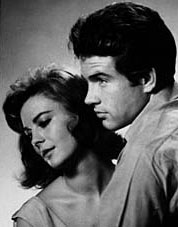

Splendor in the Grass won an Oscar for best original screenplay, and netted Natalie Wood a nomination for best actress. Set in the late 1920’s, the movie presents us with high school sweethearts Bud and Deanie (who came up with these names?) played by very young versions of Warren Beatty and Ms. Wood.
From the start, they are caught up in a feverish, all-consuming passion which, under the moral constraints of the time, they dare not consummate. The movie unfolds like a Greek tragedy and, before it’s over, this great love is destroyed beyond recovery, Natalie Wood descends into madness and winds up in an asylum, and the 1929 stock market crash takes its own ruinous toll. It’s hard to overstate the level of bleakness here.
Perhaps it was because it was late at night and I was alone and particularly susceptible, and had no idea what I was in for, but the movie drew me in heart and soul and left me practically inconsolable for days.
At the end of Splendor in the Grass, Bud and Deanie meet one last time after several years. He’s married to someone else, and she is engaged. When Deanie asks Bud if he’s happy now, he answers: “I guess so. I don't ask myself that question very often, though.” Bud in turn wishes Deanie happiness in her upcoming marriage, and she responds, “Well, like you, Bud, I don't think too much about happiness either.” Bud agrees, “What's the point? You gotta take what comes.”
I remembered this scene almost verbatim, and to me it was achingly sad. These two will probably be married to decent enough people and live out their quiet lives, but their one chance at happiness together is gone forever. So, it’s best just not to think too much about it.
The only hope offered by the movie is found in lines from the Wordsworth poem “Ode: Intimations of Immortality from Recollections of Early Childhood” from which the movie’s title is taken: sometimes, you have to let go.
What though the radiance which was once so bright
Be now for ever taken from my sight,
Though nothing can bring back the hour
Of splendour in the grass, of glory in the flower;
We will grieve not, rather find
Strength in what remains behind. . . .
So, anyway, some 30 or more years later, never having seen it since, I get this great idea to rent the movie from Netflix and let it work its melancholy magic on me all over again. Unfortunately, things didn’t quite work out as planned.
The acting was nowhere near as powerful as I remembered it, and seemed stilted and at times a bit over the top. I also realized that there was no effort whatever to try to re-create the clothing, hairstyles and manners of the 20’s and 30’s; instead, the movie was content to let everyone remain in contemporary styles of 1961. Maybe people of the 60’s didn’t notice this, but I sure did. And this overpowering love? Bud and Deanie seemed more in love with the idea of being in love than they were with each other. There was plenty of lust but not much chemistry. On top of that, despite her mental illness and institutionalization, Natalie Wood at all times remained nattily dressed, and never failed to look terrific, even in the deepest pits of despair. There were still some powerful scenes and the unbridgeable gap between parents and their children was painfully real, but overall it seemed like a lot of the air had been let out of the movie’s emotional wallop.
So, now I know the danger of seeing old favorites. My wonderful memory of this film, which I use to dwell on and force upon others from time to time, has now become hopelessly unraveled. I’ll never be able to enjoy those recollections in quite the same way again.
The funny thing here is that my disappointment in the movie underscored the very point the movie was out to make: that there are peak moments in life that you just can’t get back to. It’s tragic, but they’re gone. I’ll never have that exquisite, bittersweet pleasure of being hit over the head and laid waste by this movie again.
I’m left with Wordsworth’s advice: grieve not, rather find strength in what remains behind.
Subscribe to:
Posts (Atom)