Can't really decide on your next weapon of choice? Planning a barbecue? Want to give something special to that Republican friend? Have you considered a flamethrower?
They are totally cool and totally legal (except in Maryland. They must be registered in California.) Otherwise this weapon, forbidden by the Inhumane Weapons Convention (signed by the U.S. but that really only pertains to military use by our armed forces), is yours for the small price of $900. The absolute definition of awesome! As you can imagine, sales are as hot as the weapon itself.
Tuesday, August 25, 2015

Friday, August 21, 2015
A story of Prometheus as told by Aesop
The figure of Prometheus has remained popular in practically every period of (western) history from the 8th century BC on. Here is a lesser known tale told by Aesop:
Prometheus, that potter who gave shape to our new generation, decided one day to sculpt the form of Alethia (Veritas or Truth), using all his skill so that she would be able to regulate people's behavor. As he was working, an unexpected summons from mighty Zeus (Jupiter) called him away. Prometheus left cunning Dolus (Trickery) in charge of his workshop, Dolus had recently become one of the Prometheus’s apprentices.
Fired by ambition, Dolus used the time at his disposal to fashion with his sly fingers a figure of the same size and appearance as Alethia with identical features. When he had almost completed the piece, which was truly remarkable, he ran out of clay to use for her feet. The master returned, so Dolus quickly sat down in his seat, quaking with fear. Prometheus was amazed at the similarity of the two statues and wanted it to seem as if all the credit were due to his own skill. Therefore, he put both statues in the kiln and when they had been thoroughly baked, he infused them both with life: sacred Alethia (the spirit of Truth) walked with measured steps, while her unfinished twin, the forgery, stood stuck in her tracks.
Prometheus, that potter who gave shape to our new generation, decided one day to sculpt the form of Alethia (Veritas or Truth), using all his skill so that she would be able to regulate people's behavor. As he was working, an unexpected summons from mighty Zeus (Jupiter) called him away. Prometheus left cunning Dolus (Trickery) in charge of his workshop, Dolus had recently become one of the Prometheus’s apprentices.
Fired by ambition, Dolus used the time at his disposal to fashion with his sly fingers a figure of the same size and appearance as Alethia with identical features. When he had almost completed the piece, which was truly remarkable, he ran out of clay to use for her feet. The master returned, so Dolus quickly sat down in his seat, quaking with fear. Prometheus was amazed at the similarity of the two statues and wanted it to seem as if all the credit were due to his own skill. Therefore, he put both statues in the kiln and when they had been thoroughly baked, he infused them both with life: sacred Alethia (the spirit of Truth) walked with measured steps, while her unfinished twin, the forgery, stood stuck in her tracks.
Wednesday, August 12, 2015
Saturday, August 8, 2015
Today's Grammar Point
Naturally, we all want to improve our blogging at In Progress. So, here is Mary Norris, a query proofreader for The New Yorker, to explain the diffeence between the hyphen, the en dash and -- the crazy one -- the em dash.
Friday, August 7, 2015
Happy Birthday Andy Warhol!
If you are looking for something to do in Pittsburgh today, maybe a trip over to St. John the Baptist Byzantine Catholic Cemetery is in order.
http://www.npr.org/2015/08/07/430221619/in-warhols-memory-soup-cans-and-coke-bottles
http://www.npr.org/2015/08/07/430221619/in-warhols-memory-soup-cans-and-coke-bottles
Saturday, August 1, 2015
Overused Evolution: Part II
Unexpectedly, my little article on the banality of evolution was met will no backlash, so I’m more confident about continuing. For those who didn’t read the first post, the main theme was: why are we even talking about evolution?—it’s neither modern nor important. It’s an old idea that has morphed into the misguided “survival of the fittest” which, per biologists, should be “survival of the reproducible”—hardly a startling idea.
But popular culture sees it differently. You can find ‘serious’ analysis on the evolutionary causes of abuse, acne, anger, allergies, baby teeth, baldness, beards, large breasts, cancer, cooperation, Chinese eyes, and crying, And those are just selective A, B, C’s. For example, just like long distance running helped us hunt, baldness and loss of body hair kept us safe around our newly discovered fires. Our current culture will pretty much trace anything to an evolutionary origin, although I haven’t yet seen the evolutionary reasoning for halitosis.
Unlike Darwin, in Myk’s comment, these people see a rational hand dealing evolutionary explanations, and not randomness. Perhaps they should come up with an evolutionary reason for why our species must see rational patterns.
But, aside from being old, practically a tautology, uninformative, and, in my opinion, upside down science, the main reason evolution is not worth talking about is that it fails science’s greatest measure—it is not predictive. From Copernican heliocentrism to Boyles Law science is properly revered for what it says about the future. The Theory of Evolution, unlike the Theory of General Relativity or the Uncertainty Principle, does not help us predict anything other than species will change in some way in some long amount of time. We should be discussing genetics, not evolution.
However, and this is a big “however”, there is an exalted place for evolution—what it can tell us about the past. There is little more exciting than past species, as Jurassic World reminds us. Dinosaur books alone may have excited more children into the field of science than anything else. Evolution is fascinating, just not in explaining the present or the future. Let’s enjoy our evolutionary past, but forget the evolutionary augury.
Tuesday, July 28, 2015
The awesomeness that is history (mostly for John, but anyone else out there who likes a good history story)
This is why history is so interesting - as soon as we think we have a grasp on it, something new comes up that reorganizes how we think about the past (and the present).
http://www.theatlantic.com/national/archive/2015/07/a-skeleton-a-catholic-relic-and-a-mystery-about-americas-origins/399743/
Wednesday, July 22, 2015
Monday, July 13, 2015
Wisdom, Page for Page, Madam
There's a small murmur on the internet of voicing one's opinion on what book contains page for page the most wisdom. Granted it's a pretty silly question, but silly things may lead to great things or so the sufis would have us believe. I won't even influence you by listing some nominations seen elsewhere. The two that came to mind first for me focus on wisdom with brevity, plus they weren't listed by anyone I saw:
Franny and Zooey by J. D. Salinger
and, of course:
The Myth of Sisyphus by Albert Camus
(as a book, perhaps I must list The Myth of Sisyphus and Other Essays
Feel free to share.
Franny and Zooey by J. D. Salinger
and, of course:
The Myth of Sisyphus by Albert Camus
(as a book, perhaps I must list The Myth of Sisyphus and Other Essays
Feel free to share.
Friday, July 10, 2015
Most overused concept in the 21st century: Evolution?
The idea of evolution—that species change over time—is as old as, well, recorded history. Early Greek thought proposed that animals and humans descended from previous varieties. St. Augustine, himself, explained how forms of life had been transformed slowly over time. Of course, everyone thinks Darwin’s writings were some kind of watershed, transformative moment. Darwin did lay out some better evidence, but the ideas had been around forever. Interestingly, Darwin’s grandfather, Erasmus, wrote a long footnote on evolution in his clever and erotic poem, The Loves of the Plants and, later, another poem on evolution, The Temple of Nature (originally called the The Origin of Society). Anyway, for some strange reason, evolution/Darwinism is currently popular as a modern notion and has taken on a life of its own.
As far as I can tell this life of its own focuses on “survival of the fittest”, a term which even biologists shun. They prefer “differential reproduction”, which gives a clue why they disdain the popular phase. I’ll give the classic example.
Hardly a party goes by without someone bringing up the “fact” that the reason humans are such good long distance runners is that we evolved that way because, as hunters, we had to chase down game to survive. This could be true, but it is evolution turned on its head.
Why didn’t we evolve wings, or poison spittle, or a taste for stationary plants (vegans a million years ago), or a better sense of smell, or high frequency speech that would stun the game, or… pick whatever gene package would make hunting easier. Running all day and night must be the least effective, most excruciatingly difficult method to hunt! Plus evolution does not work that way—it needn’t make rational sense, it just happens randomly.
If long distance running is evolutionary in that sense, then no one could mate with the opposite sex until they proved they could run long distances chasing game, …and not just males. This is where biologists better recognize the meaning of evolution. What gets filtered out are traits of a species that don’t let it survive to the age of reproduction, after that it makes no difference.
Evolution is based on random genes mutating. There is no hand of a long-distance-running-god or any other fictional science-god involved. It’s not what could make us better, but what makes it to reproductive age. I don’t think being good at cross country would qualify.
A gene package to be weeded out by evolution would seemingly be one that is susceptible to a fatal disease. The example that comes to mind is the Bubonic plague, but even that didn’t kill susceptible people before puberty. So, while it helped the genetic pool (at a cost), for the most part, we are still not immune. Over the next million years we need more outbreaks.
Genes in our species are so diverse that I’m not sure what would qualify for 100% saturation in a million years. One that seems to qualify for elimination would be a genetic package that inhibits mating with the opposite sex. Wouldn’t that be filtered out in a few million years? But, surely, that is not so. We have theories why not, but, again, they seem to be asserting some sort of overall benefit to the human race. Homosexuals may suffer, but, in the end, it makes the human race as a whole more reproductive.
This seems to be science conjuring up some rationalistic god to explain, in convoluted ways, random events. I guess I’m not persuaded by these why-the-elephant-got-its-trunk stories. They seem simplistic and forced, but I’m no evolutionary biologist. Help me out.
As far as I can tell this life of its own focuses on “survival of the fittest”, a term which even biologists shun. They prefer “differential reproduction”, which gives a clue why they disdain the popular phase. I’ll give the classic example.
Hardly a party goes by without someone bringing up the “fact” that the reason humans are such good long distance runners is that we evolved that way because, as hunters, we had to chase down game to survive. This could be true, but it is evolution turned on its head.
Why didn’t we evolve wings, or poison spittle, or a taste for stationary plants (vegans a million years ago), or a better sense of smell, or high frequency speech that would stun the game, or… pick whatever gene package would make hunting easier. Running all day and night must be the least effective, most excruciatingly difficult method to hunt! Plus evolution does not work that way—it needn’t make rational sense, it just happens randomly.
If long distance running is evolutionary in that sense, then no one could mate with the opposite sex until they proved they could run long distances chasing game, …and not just males. This is where biologists better recognize the meaning of evolution. What gets filtered out are traits of a species that don’t let it survive to the age of reproduction, after that it makes no difference.
Evolution is based on random genes mutating. There is no hand of a long-distance-running-god or any other fictional science-god involved. It’s not what could make us better, but what makes it to reproductive age. I don’t think being good at cross country would qualify.
A gene package to be weeded out by evolution would seemingly be one that is susceptible to a fatal disease. The example that comes to mind is the Bubonic plague, but even that didn’t kill susceptible people before puberty. So, while it helped the genetic pool (at a cost), for the most part, we are still not immune. Over the next million years we need more outbreaks.
Genes in our species are so diverse that I’m not sure what would qualify for 100% saturation in a million years. One that seems to qualify for elimination would be a genetic package that inhibits mating with the opposite sex. Wouldn’t that be filtered out in a few million years? But, surely, that is not so. We have theories why not, but, again, they seem to be asserting some sort of overall benefit to the human race. Homosexuals may suffer, but, in the end, it makes the human race as a whole more reproductive.
This seems to be science conjuring up some rationalistic god to explain, in convoluted ways, random events. I guess I’m not persuaded by these why-the-elephant-got-its-trunk stories. They seem simplistic and forced, but I’m no evolutionary biologist. Help me out.
Monday, June 29, 2015
Required Viewing
From Annie Hall:
Man in Theatre Line: Wait a minute, why can't I give my opinion? It's a free country!
Alvy Singer: He can give it... do you have to give it so loud? I mean, aren't you ashamed to pontificate like that? And the funny part of it is, Marshall McLuhan, you don't know anything about Marshall McLuhan!
Man in Theatre Line: Oh, really? Well, it just so happens I teach a class at Columbia called "TV, Media and Culture." So I think my insights into Mr. McLuhan, well, have a great deal of validity!
Alvy Singer: Oh, do ya? Well, that's funny, because I happen to have Mr. McLuhan right here, so, so, yeah, just let me... [pulls McLuhan out from behind a nearby poster]
Alvy Singer: come over here for a second... tell him!
Marshall McLuhan: I heard what you were saying! You know nothing of my work! You mean my whole fallacy is wrong. How you got to teach a course in anything is totally amazing!
Alvy Singer: Boy, if life were only like this!Well, sometimes life can be like this, as many of us well know -- as when Alex Haslam, professor of psychology now at the University of Queensland, Australia, commented on our blog post discussing his view of the implications of the Milgram experiment. His comments became part on an ongoing discussion in this blog about the issues raised by the Migram experiment, such as the "banality of evil" and the ability of tyrants to enlist the assistance of ordinary people in programs of cruelty and oppression. See Re-thinking the Milgram Study, Thinking about Re-thinking the Milgram Study, Penn State and the Milgram experiment, Thinking Milgram, Once Again.
In 2001, Haslam along with his colleague, Stephen Reicher, conducted his own well-known experiment to examine the psychology of tyranny, known as the BBC prison study. The study examined the behavior of 15 men who were placed in a social hierarchy of guards and prisoners within a custom-built environment. This study was similar to a previous study conducted by Philip Zimbardo in 1971, called the Stanford prison experiment.
According to Zimbardo, the Stanford experiment showed how individuals, simply as a consequence of assigning them the role of either guard or prisoner, became increasingly brutal or passive. But it also showed that there could be resistance to oppression. Haslam wanted to explore these issues further in his experiment.
Anyway, in view of all this, it would seem that the following movie to be released on July 17, 2015, should be considered required viewing for our regular blog readers:
Sunday, June 28, 2015
Striking Colors
Alabama Gov. Robert Bently has ordered the removal of a Confederate flag from its capitol grounds. Governors of South Carolina and Mississippi have also called for the Confederate flag to be taken down from their state capitols. Walmart, Amazon, eBay and Sears all announced bans on the sale of Confederate flag merchandise. Is this the South's final retreat? See Last Battles.
Thursday, June 25, 2015
The Breaking of the Atomic Book Club
I guess James was spot on a few years ago. The club lasted just about 2 weeks. I am continuing to read, so I might post something from time to time. I like the book quite a bit. These are incredibly intelligent and interesting people—scientists' scientists who, surprisingly, are very human. Many are extremely articulate—Polanyi, Bohr, and Heisenberg, so far. I've been fascinated by Polanyi. Here are a few things he said which are not in the book, at least not yet:
“In so far as a theory cannot be tested by experience—or appears not capable of being so tested—it ought to be revised so that its predictions are restricted to observable magnitudes.”
“as human beings, we must inevitably see the universe from a centre lying within ourselves and speak about it in terms of a human language shaped by the exigencies of human intercourse. Any attempt rigorously to eliminate our human perspective from our picture of the world must lead to absurdity.”
“Christianity sedulously fosters, and in a sense permanently satisfies, man's craving for mental dissatisfaction by offering him the comfort of a crucified God.”
Tuesday, June 9, 2015
A little late to the party - Parks & Rec
We just started watching Parks and Rec on Hulu from the beginning. We are 5 episodes in and already hilarious. However, the comment I wanted to make was to assure those of you have seen the who and also have never worked in local government, that is EXACTLY how local government is. Just in case you were wondering.
Thursday, June 4, 2015
Sunday, May 31, 2015
Empirical Evidence
“Intoxicating symmetry, the prize,
Converted all but science into lies.”
—An Enigma on Man
[Although the poem, “An Enigma on Man”, is certainly “…a triumph!”, it apparently is an unreadable one, so despite my continuing edits, it may never see the light of day. Nevertheless I will probably quote it from time to time.]
In our current age empirical evidence, often called scientific evidence, is evidently king. Of course some, like Michael Polanyi and, Myk’s favorite, Thomas Kuhn, have cautioned equating truth with data. I would like to relate a peculiar story told by Steven Pinker in a Ted Talk about some incendiary criticisms to his book, The Blank Slate: The Modern Denial of Human Nature. This story has a little relevance to the Fishtown discussion, but only tangentially. Mostly it is a story how conclusions about human behavior are difficult to come by.
Pinker begins talking about the censure he and others have received for presenting unpopular conclusions from research. He tells about his favorite example: a pair of researchers who were criticized for doing a study about left-handedness—collecting data and concluding that left-handers are, on average, more susceptible to disease, more prone to accidents, and have shorter life-spans. Soon the two were barraged with enraged letters, death threats, and banned by scientific publications. The rage, as you might guess, came from left-handers and their advocates.
And then Pinker makes an off-handed comment about the pair's research, for which I really admire him:
“it’s not clear, by the way, whether that is an accurate generalization, but the data at the time seemed to support that.”Friday, May 22, 2015
Do teach your children quantum mechanics
On the one hand, some views and ideas fall under the aegis of child protection. The concept of God, for example, is so gapingly profound that it is perilous to children. In almost all cases a child’s notion of God becomes a strain which later must be stressfully rejected, obediently acquiesced, or strenuously relearned. I think it possible that many of the religious problems of today could have been avoided if the idea of God had been left to be taught later in life.
On the other hand, some seemingly indecipherable concepts should be taught to children soon after the quixotic age of reason. Most important of these, I believe, is quantum theory.
Quantum mechanics is the most evidentially “true” description of our world. It is the only belief for which there is not one single refuting experiment. No other scientific theory can claim that. It is so fundamental that it covers everything we call reality. Simply put, it is our best description of how reality behaves, and it's nothing like one would expect. Yet, shockingly its most basic facts are unknown by the vast majority, and unlike Fishtown or Belmont, that ignorance is indiscriminate among the rich, poor, educated or uneducated.
It is unconscionable that middle schoolers, high schoolers and, even, college graduates typically know nothing about the discoveries learned a hundred years ago which completely changed our knowledge of reality. Please don't bother to post a Feynman quote about how no one understands quantum mechanics. I prefer Kurt Vonnegut: “…any scientist who couldn’t explain to an eight-year-old what he was doing was a charlatan.” Indeed, some basic tenets of quantum mechanics and the experiments that revealed them are quite simple and are easily understood. If children learned these, they would have a lifetime of experiencing life filtered through that knowledge, rather than a lifetime filtered through our intuitive Newtonian physics. Certainly, such a lifetime would lend itself to developing a better understanding of the reality of quantum physics.
Today, unschooled, we find the “purchased praise of petty things" in quantum pet care, quantum herbal products, and quantum time travel. With something so closely tied to explaining reality, I’m tottering on some conspiracy theory of why almost a hundred years later, children (and adults) have been taught nothing.
In ten minutes any child could learn the double slit experiment, complementary properties and entanglement, and the uncertainty principle, and begin thinking about their meaning. How can we not be better off if we know how nature actually works rather than being fooled by our ancient intuitive perceptions?
Brian Greene, like Carl Sagan and Neil deGrasse Tyson, are smart guys who love to ham it up. The fundamentals of this Nova episode, The Fabric of the Cosmos: Quantum Leap are excellent. Unfortunately, however, what could have been dramatically revealed in 15 minutes is over-hyped for the supposed ADD viewer. Filter out all the extraneous noisy nonsense and it covers the topic properly. (Note Alain Aspect whose experiment was my choice for "The Most Important Event of the 20th Century").
Monday, May 18, 2015
Sorry...More on Fishtown
Some people just won't let a thing be.
On Saturday, I was unable to attend the annual Kensington Kinetic Sculpture Derby because it conflicted with Tom Nascenzi's graduation party.
To enter this derby, you must make a sculpture and it must be able to move and that movement must be generated by human power. After that, you're pretty much on your own. You display your sculpture by driving through a course through the streets of Philadelphia. For reasons not entirely clear, the course ends at a big mudpit.
Anyway, here is the course:
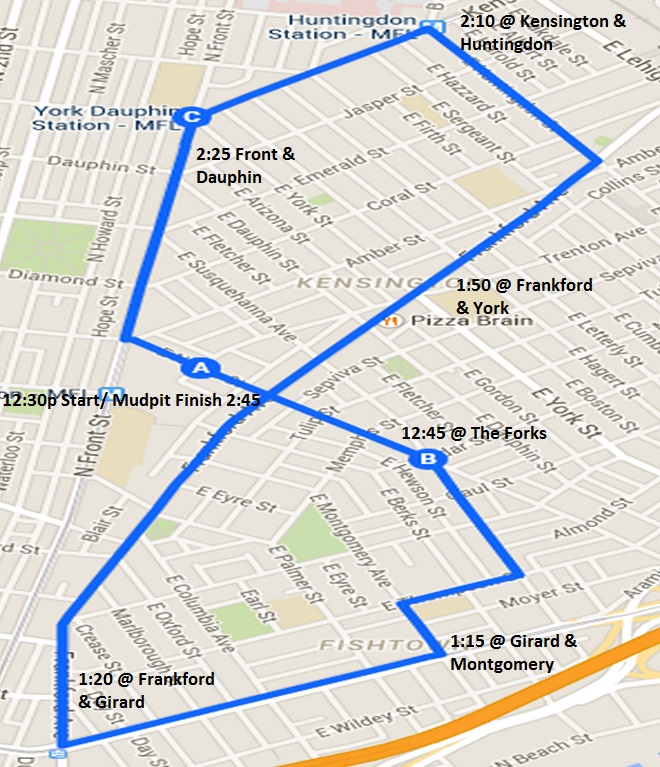
As you can see, the route includes Fishtown -- shown at the bottom. In fact, Ellen tells me that, even though it's called the Kensington Kenetic Sculpture Derby, most of the route is in Fishtown and it should be re-named.
It all takes me back to Charles Murray's Coming Apart. Check out the video below. After seeing it, I just can't imagine missing the mark more widely than using Fishtown as a symbol of white working-class malaise. If nothing else, where were Murray's editors? If this is America at rock bottom, I'd say we're doing pretty well.
On Saturday, I was unable to attend the annual Kensington Kinetic Sculpture Derby because it conflicted with Tom Nascenzi's graduation party.
To enter this derby, you must make a sculpture and it must be able to move and that movement must be generated by human power. After that, you're pretty much on your own. You display your sculpture by driving through a course through the streets of Philadelphia. For reasons not entirely clear, the course ends at a big mudpit.
Anyway, here is the course:
As you can see, the route includes Fishtown -- shown at the bottom. In fact, Ellen tells me that, even though it's called the Kensington Kenetic Sculpture Derby, most of the route is in Fishtown and it should be re-named.
It all takes me back to Charles Murray's Coming Apart. Check out the video below. After seeing it, I just can't imagine missing the mark more widely than using Fishtown as a symbol of white working-class malaise. If nothing else, where were Murray's editors? If this is America at rock bottom, I'd say we're doing pretty well.
Quiet
Taking a break from the atom bomb, I picked up the book Quiet by Susan Cain (a book I gave Megan for Christmas). If you haven't read this one yet, I definitely recommend it - especially for those with little kids, this is a bit of an eye-opener on being an introvert and how we basically work hard as a culture to push everyone to be an extrovert. And for James, there is a page on one of BBDO's founders, Alex Osborn and his creation of "brainstorming" and how it is one of the worst ways to inspire creativity. A thought provoking book.
Friday, May 15, 2015
Mother Died and Other Stories
“Mother died today” opens Camus’ The Stranger. I almost started my email last Wednesday with that line. It was a dispassionate fact. Yet not. It was relief. It was terrifying. It finally ended my role as Sneelock. It revealed the one real, startling fact of all life. It mocked as failure my efforts for a large chunk of my life. It was what she had wanted for many years. It ended an era. So, like everything in life, it was filled with mixed emotions.
In fact, the opening line of Camus’ The Stranger has been mistranslated. He does not use the word “mother”, for which I have been properly criticized for using in the past. The word is “maman”, which translates somewhere between “mother” and “mommy”—mixed emotions.
Mom’s last coherent words were spoken to Gabi, the caregiver, as she bent over mom in her chair and whispered something to gain an acknowledgement or response. Mom noticed her bracelet and said, “What a pretty bracelet!”
Gabi, delighted at the response, continued with something like, “Yes, it is the one instance where my husband showed good taste.”
Mom’s response in some ways summed up her whole life and its message to others, “Oh, you’re too critical.”
Subscribe to:
Posts (Atom)