Monday, October 24, 2011

Quote of the Day

Guess which countries have a greater income inequality than U.S.?
(Gini coefficient on data from 2001-2009)

Mexico
United Kingdom
Vietnam
Iran
China
South Africa
Turkey
India
Haiti
Egypt
Greece
Russia
Nigeria

Thursday, October 20, 2011

Today's Quote

History is a race between education and catastrophe.
H.G. Wells

(Katy and Sean, please take note.)

Wednesday, October 19, 2011

The Future's So Bright I Gotta Wear Shades.

Steven Pinker, the Harvard psychologist, has graced the pages of this blog before. See On Taboo. Now, he provides us with a significant counter-narrative to the views of the cynic in his new book, "The Better Angels of Our Nature."

According to the New York Times Review of Books, "The central thesis of 'Better Angels' is that our era is less violent, less cruel and more peaceful than any previous period of human existence. The decline in violence holds for violence in the family, in neighborhoods, between tribes and between states. People living now are less likely to meet a violent death, or to suffer from violence or cruelty at the hands of others, than people living in any previous century."

Pinker supplies a lot of statistical – and some anecdotal – evidence to prove his point. But, for me the more interesting issue is why: why is the arrow of history pointed toward more human decency? Pinker doesn't claim to know for certain, but he has some theories. One is what I call the socialist theory. This theory claims that the development of the state monopoly on violence reduces violence among its own citizens. A state which has a disproportionate ability over its citizens to inflict violence has the power to impose penalties that eliminate the incentives for aggression. We see the rise in violence in places like Somalia where government is virtually non-existent or in marginalized places in this country where law enforcement is ineffectual and the mob or drug lords still act with impunity.

The second theory is what I call the capitalist theory. It says that the ability to trade our surpluses with pretty much anyone in the world for their surpluses creates a positive sum result in which both parties benefit. It's not hard for people to see that this arrangement is preferable to the zero sum outcome of war. As Robert Wright, the original proponent of this theory, put it, "Among the many reasons that I think that we should not bomb the Japanese is that they built my mini-van."

Perhaps, the most intriguing theory is based on the fact that people are simply getting more reasonable. Here's what the New York Times Review said:
Pinker's claim that reason is an important factor in the trends he has described relies in part on the "Flynn effect" — the remarkable finding by the philosopher James Flynn that ever since I.Q. tests were first administered, the scores achieved by those taking the test have been rising. The average I.Q. is, by definition, 100; but to achieve that result, raw test scores have to be standardized. If the average teenager today could go back in time and take an I.Q. test from 1910, he or she would have an I.Q. of 130, which would be better than 98 percent of those taking the test then. Nor is it easy to attribute this rise to improved education, because the aspects of the tests on which scores have risen most do not require a good vocabulary or even mathematical ability, but instead test powers of abstract reasoning.
The jury is still out on the causes of the Flynn effect. But, because evolution can't work that fast, it can't be that we are biologically smarter than our ancestors. Rather, it suggests that the brain is fairly malleable and is influenced by environment. Many suggestions have been made, including proposals that better nutrition or more emphasis on timed test-taking improve scores.

The most convincing argument, however, is that, because we live in a more complex environment which requires more abstract thinking, our minds have trained themselves to think more logically. Here's what Flynn himself had to say, "We weren't more intelligent than they [our ancestors], but we had learnt to apply our intelligence to a new set of problems. We had detached logic from the concrete, we were willing to deal with the hypothetical, and we thought the world was a place to be classified and understood scientifically rather than to be manipulated." Flynn's belief was that, as our minds expand their abilities, we will continue to create more complex environments, which will in turn stretch future minds to even higher functioning and more complex environments. Who knows where this ever expanding circle of intellectual capacity might lead? It makes us envious of the future generations.

According to Pinker, given our increased reasoning powers, we now have the ability to detach ourselves from our immediate experience and from our personal or parochial perspective, and understand our own situation in universal terms. Pinker suggests that the increased ability to think outside our own particular box moves us toward moral advances – mostly by the recognition that, from the standpoint of the universe, no one holds any position more privileged or more deserving than anyone else. In other words, we finally get what it means to say that what is sauce for the goose is sauce for the gander. So, if we prefer life over death and happiness over suffering, we can't expect anyone to accommodate us unless we're willing to accommodate others. This perception, captured in the golden rule, was once the exclusive insight of religious visionaries. But now through the Flynn affect it is within the intellectual grasp of almost everyone.

Pinker calls this the moral Flynn effect. We're not only getting smarter; we getting better. And, if Flynn is correct, these advances will happen at an ever increasing rate. Hey, the future's so bright I gotta wear shades.


Here is where we must draw the line

This drawing of Vermeer's Girl With a Pearl Earring was made by Hwee Chong by starting in the center and drawing one continuous line in an ever expanding spiral. The details are achieved by varying the thickness of the line. Here are more drawings by Hwee and a video showing him work (in fast motion).

Tuesday, October 18, 2011

Ridicule Redux

Two important dates are coming at the end of this month.

October 21, 2011
That's God's well hidden date for the end of the world. One very dedicated sleuth extricated the date from its biblical cypher. Unfortunately Harold Camping's reward for outsmarting God and coming up with the start of the rapture, on May 21, has been ridicule. Undaunted by God's sense of humor, he proclaimed Rapture Redux for October 21.

October 28, 2011
Even more sensational, at least for those of us remaining, is Cold Fusion Redux. You will recall that Martin Fleischmann and Stanley Pons received the world's ridicule in 1989 when they announced they had achieved cold fusion using deuterium and palladium metal. Their published experiment was never duplicated.

Andrea Rossi and Sergio Focardi will attempt a new cold fusion demonstration, renamed LENR (low energy nuclear reaction), based on Rossi's E-Cat (Energy Catalyzer). The process reportedly uses nickel and hydrogen and yields a byproduct of copper and iron. The two have performed demonstrations in the past to closed groups. This one will be on a much grander scale coupling 52 individual table top modules into one storage container sized plant that will produce 1 megawatt of self sustaining energy. If the demonstration is successful, it could change the world more than the internet, by allowing practically unlimited energy at almost no cost. The press has been understandably reluctant to report Rossi's work, but that may change on October 28. Here is a story in Forbes that includes plenty of further links if you are interested.

Monday, October 17, 2011

Quote of the day


I am your personal headache

This post is for Bill (and others who have just received a new iPhone 4S). Bill was showing me some of the phone's capabilities at mom's on Sunday. It looked very nice.

In anticipation of the web being flooded with humorous Siri videos, I will post a nice one from AppleInsider.


  • Note that, like any foreign encounter, when we aren't understood, we just talk louder. 
  • This will be annoyingly rich fodder for the Apple Lovers vs. Apple Haters for years. 
  • I applaud Apple's latest attempt at Voice Interface-Speech Recognition-Artificial Intelligence. It will take time before humans and machines can have comfortable conversations, but I suspect the real power of Siri is not so much AI (which is excruciatingly hard for language) but massive amounts of data in servers delivered over the internet (I hate the term 'cloud', but I guess I will have to live with it). Siri need not be that smart with Speech AI if it can simply latch on to a catch word or phrase as "breakfast" or "restaurant" and link it to a service. 
  • How long will it be until Jay Leno uses Siri as a comedy sketch? (see Newton)
  • The best thing Apple did for its own self esteem, was to call this 'beta'.

Sunday, October 16, 2011

It Might Be Better in September but It's Not Over in October

Sue and I just returned from another magical week in Beach Haven, where we were joined by Jim. You might think that the second week in October is too late in the year to enjoy the beach in New Jersey, but you would be wrong.

We arrived last Saturday, and for the first several days we enjoyed sunny weather with temperature in the mid-80's. Even when the days became overcast, the temperature was still in the 70's and the water temperature remained warm throughout. If anything, the water seemed to get warmer.


On Sunday, Johnny, Gail and Carolyn came down and spent to day. Carolyn brought enough food to feed an army. We spent an enormously enjoyable afternoon together at the beach and then a dinner to match afterwards.

Things turned cloudy and blustery on Wednesday and Thursday. Notwithstanding the fact that I have been going to Long Beach Island since 1960, we made two excursions to places I had never been to before. First, on Wednesday, we decided to visit the Holgate Unit of the Edwin B. Forsyth Wildlife Refuge. This is the southern part of the island that continues on after the road ends. Its only open in the off season, so we figured this was our one chance to see it. For anyone looking for wildlife, the place is a total bust. In fact, there's nothing much there at all, except some beach and sand dunes. We took the opportunity, however, to walk to the absolute southern tip of the island. It was a two and half mile trudge in the sand. We managed the trip south without too much difficulty. The trip back into a stiff and constant headwind was another story. Every step was an effort. I had images of Robert Scott's ill-fated expedition to the south pole. He reached the pole with little incident, but on the return journey, all five members of his expedition perished from a combination of exhaustion, starvation (we hadn't eaten since breakfast) and the cold. I am happy to report that we did in fact survive.


The other trip we took was to the Tuckerton Seaport & Baymen's Museum. This is a re-creation of a maritime village. Although it gives the impression of being a low-budget affair, it contained exhibits about plenty of things I knew nothing about, including the origins of the U.S. Life Saving Service, the surprising number of shipwrecks in the 1800's off the Jersey and Long Island coasts, the privateers operating from New Jersey waters in the 1700's and something called pound fishing. To say nothing of the fact that the Seaport houses the only surfing museum in the state of New Jersey.

All the high winds churned up some pretty big waves by the end of the week. Unfortunately, for one who is no longer young and spends 51 weeks out of the water, the waves were a bit too far out and too difficult to catch for me. It didn't stop us, however, from having a great time.

Friday, October 7, 2011

Which T-shirt should I bring to the beach?

Out of my clothes cabinet I grabbed a handful of T-shirts:
1. Family First Sports Park Indoor Soccer - Sockers (when I played soccer in Erie)
2. Myk's Mopeds, Inc. Beach Haven, NJ (surely a collector's item)
3. THEY WILL RUN AND NOT BE WEARY - ISAIAH 40:31 (a present from Myk)
4. Tie dye T-Shirt (a present from Renée)
5. Taste & Quick Keys - Software That will Knock You On Your Axis (from a MacWorld Expo)
6. Return of RUN LIKE HELL - You could use the exorcise! (from when we battled the radio talk show host and lost)

[This is a variation of "What books are on your bedside table?" Feel free to take a handful of T-shirts from your dresser and report.]

Can Troy Get Any Cooler


Also, this post was done with the latest interface for posting so best of luck for posters, as a reminder try to keep all post normal size and Helvetiva unless for creative purpose. (uniformity is pretty). 

Thursday, October 6, 2011

The Death of God and the Euthyphro Dilemma

Back in August there was an article in The New Yorker by James Wood entitled "Is That All There Is? Secularism and its discontents." It was a review of a recent book called "The Joy of Secularism: 11 Essays for How We Live Now" edited by George Levine.

Many writers have spoken about secularization and the loss of religion as a grim if not catastrophic event. "The fate of our times," writes Max Weber, "is characterised by rationalisation and intellectualisation and, above all, by the 'disenchantment [entzauberung] of the world.'" Nietzsche is even more sobering. For him the death of God is announced by a madman who also sees the dire consequences:

"Whither is God?" he cried; "I will tell you. We have killed him – you and I. All of us are his murderers. But how did we do this? How could we drink up the sea? Who gave us the sponge to wipe away the entire horizon? What were we doing when we unchained this earth from its sun? Whither is it moving now? Whither are we moving? Away from all suns? Are we not plunging continually? Backward, sideward, forward, in all directions? Is there still any up or down? Are we not straying, as through an infinite nothing? Do we not feel the breath of empty space? Has it not become colder? Is not night continually closing in on us? Do we not need to light lanterns in the morning? Do we hear nothing as yet of the noise of the gravediggers who are burying God? Do we smell nothing as yet of the divine decomposition? Gods, too, decompose. God is dead. God remains dead. And we have killed him."
Levine's collection of essays take a more positive view and argues generally that secularism is a good thing. The essays don't criticize religion but contend that life without God is not so bad. I didn't think that the Wood article contained all that many revelations and I was slightly disappointed. But its discussion of secularism and morality is worth noting.

And this brings us to Euthyphro. Euthyphro is one of Plato's early dialogues. Socrates engages Euthyphro, a man known for claiming to be a religious expert, in a discussion over the definition of piety. In the course of the dialogue, Euthyphro claims that piety is what is pleasing to the gods. At this point, Socrates asks the question: "Is piety loved by the gods because it is pious, or is it pious because it is loved by the gods?" Put in more contemporary prose, the question is: is the moral law loved by the gods because it is moral or is it moral simply because it is loved by the gods?

It is this second alternative that leads religious people to say, if there is no God, then everything is permitted – as if it is by God's decree that something is made good or bad. Under this notion, morality just becomes a test of fidelity to God and is essentially arbitrary. However, even in ancient times, people recognized that God's wanting something alone did not make it good. Xenophanes of Colophon saw that the gods were not perfect and, more to the point, were terrible role models, getting away with stuff for which ordinary humans would be punished: "Homer and Hesiod have attributed to the gods all things that are a shame and blameworthy among men, stealing and committing adultery and deceiving each other."

And in the Bible, when God wants to destroy Sodom and Gomorrah, Abraham appeals to a higher sense of justice: "Far be it from you to do such a thing, to put the righteous to death with the wicked, so that the righteous fare as the wicked! Far be that from you! Shall not the Judge of all the earth do what is just?" Gen. 18.25. Moses later talks God out destroying the Israelites for having worshipped a golden calf, mostly arguing that, if He does this, He'll look bad: "Why should the Egyptians say, 'With evil intent did he bring them out, to kill them in the mountains and to consume them from the face of the earth'?" Moses also reminds God of His promise to Abraham, Isaac, and Israel, suggesting that even God should keep his word. Ex. 32:7 -14.

Can we even trust Jesus? He curses a fig tree and causes it to whither simply because he was hungry and the tree bore no figs. Mark even says that figs were out of season at the time. Matt. 21:18-22; Mark 11:12-14, 19-25. Jesus also quite casually sends unclean spirits into a herd of pigs numbering about two thousand causing a local farmer to lose his entire stock as they all rush into the sea and are drowned. Mark 5:1-17. In the first instance, Jesus seems petty; in the second, inconsiderate.

So, it seems that, even for the religious fellow, the law of God (or religion) must take a back seat. Thomas Aquinas himself says: "It is better to perish in excommunication than to violate one's conscience." Religion never removed the need to judge morality ourselves. So, as Wood rightly recognizes, one thing secularization and the death of God will not do is cast us out into the wilderness of moral uncertainty. We are already there.


Sunday, October 2, 2011

Screenings - Pelada

Pelada (2010)
Writer/Directors: Luke Boughen, Rebekah Fergusson, Gwenolyn Oxenham, Ryan White
Genre: Documentary

It's the Endless Summer of soccer, or rather futbal. Unpretentious and extremely enjoyable. Even if you don't like soccer, you will like the movie. If you like soccer, it's a triumph!
(can be streamed on Netflix)

Tuesday, September 27, 2011

For Republicans, No Good Deed Goes Unpunished

For a Republican presidential candidate, doing the decent thing turns out to be a political liability.

Perry faces several problems along these lines. The first was his decision to grant in-state college tuition to illegal immigrants. Perry gets attacked regularly from the likes of Romney and Santorum, and boos from the audience whenever he defends the plan. Santorum -- in a statement that reveals a bit too much about his own bias -- suggested that the in-state tuition “was an attempt to attract the illegal vote – I mean, the Latino voters.” The argument is that the in-state tuition only encourages illegals to cross the border with their kids in tow so that eventually their sons and daughters will be able to get the lower tuition not available to them if they stayed in Mexico. (To be eligible for the lower tuition, an illegal must have resided in the state over three years.) Of course, taking steps to see that kids who came into this country through no choice of their own get an education and the chance to better themselves is simply not heartless enough for many Republicans.

Perry also gets criticized for his executive order (never implemented) that mandated girls in Texas get the HPV vaccine. Michele Bachmann characterized the mandate as “innocent little 12-year-old girls” being “forced to have a government injection through an executive order,” putting Texas more or less in the same category as Nazi Germany. And, in an act of incredible irresponsibility, Bachmann claimed, against all evidence, that HPV vaccines can cause “mental retardation.” Meanwhile, cervical cancer strikes about 12,000 women a year and kills about 4,000. The vaccine will prevent the viral strains that cause about 70 percent of those cancers.

Perry also catches heat for opposing the colossally stupid 1200-mile fence along the entire Texas-Mexico border. Santorum says Perry is weak on immigration because he opposes the fence. I suppose we need go no further than Robert Frost: "Good fences make good neighbors."

Romney has his own problems with being a decent human being. He has to defend his universal health care initiative requiring residents of Massachusetts to buy health insurance. The result of this legislation is that more than 98 percent of Massachusetts’ residents now have health insurance, including 99.8 percent of all children, making Massachusetts’ rate of uninsured the lowest in the country. The plan has not contained costs as intended, but 88% of medical doctors in Massachusetts say that health care in the state is as good or better since the plan has been in place. In another demonstration of her higher intelligence, Bachmann claimed in a debate that the Massachusetts plan violated the constitution – but, on further questioning, could not cite which provision it violated.

On the other hand, if you want to avoid the boos and get the Republican crowd cheering wildly, you only need remind them of Texas's death row executions. In the September 7 debate, when moderator Brian Williams began a question by telling Perry that his state “has executed 234 death row inmates, more than any other governor in modern times,” sudden applause erupted throughout the audience.

Old time religion

I haven't seen any religious posts in a long time (Myk, where have you been?) so I thought I'd do one. This one's on Prayer (you still with me?)

I pray a lot. Grace, lot's of hail mary's and glory be's (Shorter the better.) I get rid of the "thy's" and "thous". It's just not normal. (I haven't asked anyone to "take thy turn", for instance, in a long time.)

My favorite payer is the Hail Mary--just the first part, it's short it's simple and I see it as in praise of Maureen and the kids. (Maureen being Irish for Mary.)(My one confession in Ireland I was told to say "Three Hail Maureen's" for my penance.) It goes like this "Hail Maureen, full of grace (she is), the Lord is with You (He is), blessed are you among women (once again, although prejudiced, I agree), and blessed is the fruit of your womb (How can I dispute that!)

Here's the thing, if each of us has a bit of god in us, then why not direct our prayers each other. At my best, when I look into someone's eyes, I see god, so why not pray to him or her. Isn't that the best way to pray?

Like the Act of Contrition (A prayer that I can't get out of my head. Not my second favorite prayer by any stretch, but my second most prayed prayer behind the "Hail Maureen".

"O my god (yes, it's you I'm talking to face to face, hand in hand, I can feel your breath on me, you and I are a part of a living god) I am heartly sorry for having offended you and I detest all my sins because I dread the loss of heaven (losing being with you) and the pains of hell (being without you), but most of all (it's not me I'm thinking of mostly) because it offends you my god (still feeling your breath on me, and the touch of your hand) you are all good and deserving 0f all my love. I firmly resolve, with the help of your grace (I am nothing without your grace, please confer your grace on me so that I can make it through) to confess my sins (being open and honest to you), to do penance (how can I make this up to you?) and to amend my life (only with the help of your grace). Amen."


Saturday, September 24, 2011

RE: Exciting Times

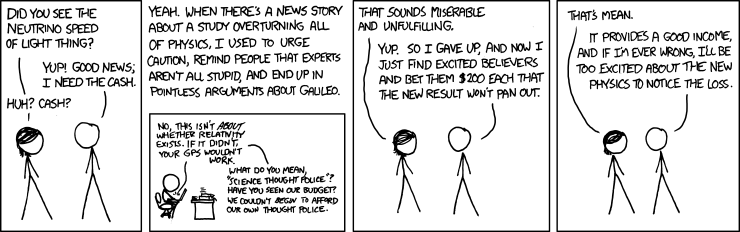
Regarding "Exciting Times" and neutrino speed findings, cartoonist counsels caution:

Friday, September 23, 2011

Thursday, September 22, 2011

Exciting Times

Recently, two separate scientific possibilities may (merely may) rock our current view of the universe. I emphasize possibilities, because neither of these have been verified yet, but will be in the coming days or months.

The first is that there is a good chance that the predicted Higgs boson does not exist.
In just five months running the Large Hadron Collider, two teams have eliminated – at a 95 percent confidence level – most of the range of possible masses the Higgs could have, Vivek Sharma, a physics professor at UC San Diego, reported at the biannual Lepton-Photon conference held recently in Mumbai, India. “The Higgs, if it exists, is now trapped between 114 and 145 GeV (Giga-electron volts, a measure of mass),” he said.
If it turns out that the Higgs boson does not exist, it's back to the drawing boards, as the 'Standard Model' of how fundamental forces interact, which has been our best explanation for the last 40 years, depends on the existence of the Higgs boson.

Secondly, and this is more tentative, scientists may have discovered that neutrinos travel slightly faster than light, which as you know violates relativity.

These are exciting times, for there are no more exciting times than when science discovers that it is wrong in fundamental ways. It's our chance to be even more creative in explaining the universe. As Richard Feynman warned, "I think that nature's imagination is so much greater than man's, she's never going to let us relax."

Edit: As suspected, the discovery that neutrinos have been found to travel faster than the speed of light was announced today.

Wednesday, September 21, 2011

We need more voting

This also could be a quote of the day. The L.A. Times ran an article in their science section concerned about where debris from NASA's Upper Atmosphere Research Satellite (UARS) will land on earth. In the article was the following:

A poll item on ABC News' website asked readers where they thought UARS would crash. Possible answers were "Harmlessly in the ocean," "In mountains or open plains," or "My house!" As of Wednesday afternoon, "My house!" was leading "In mountains or open plains" by a margin of 2 to 1.

Saturday, September 17, 2011

Congrats to No. 1 ranked Maryland

After scoring the last goal in the history of Schenley H. S., Martin heads to Maryland where they immediately become the top ranked team in the country. Coincidence? We wonder.